
Guide · Nov 2, 2026
Pay for Delete Letter: How It Works and Whether Collectors Agree
A pay for delete letter offers to pay a collection account if the collector removes it from your credit reports. Here's what the CFPB and federal law say, when it might help, and how to write one.
By Michael Gonzales · Last updated

Short answer: A pay for delete letter offers to pay a collection account if the collector agrees to remove it from your credit reports. No law requires a collector to agree. Federal rules say accurate collection accounts can stay on your report for 7 years, and no one has the right to remove accurate negative information [1][2].
So a pay for delete is a request, not a right. Some collectors say yes, many say no, and a promise to delete only helps you if you get it in writing before you pay [3].
DebtHaus is not a law firm. This page explains federal law in general terms and isn't legal advice for your situation. If you've been sued over a debt, talk to a consumer attorney or your local legal aid office before your response is due.
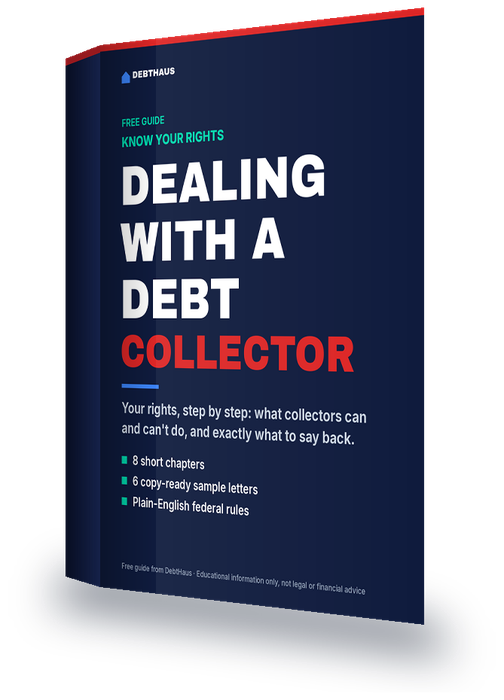
Dealing With a Debt Collector
Your rights, step by step, plus 6 sample letters. A free 29-page PDF sent to your inbox.
We email you a confirmation link first. No spam, unsubscribe anytime.
What is a pay for delete letter?
It's a letter you send to a debt collector (or the company that now owns the debt) that says, in plain terms: I'll pay this amount, and in return you'll ask the credit bureaus to delete the account.
It usually comes up with collection accounts, not with your original credit card or loan account. The offer can be for the full balance or for a smaller settlement amount.
The letter is only a proposal. Nothing in the Fair Credit Reporting Act or the debt collection rules gives you a right to trade payment for deletion.
Do debt collectors have to agree to pay for delete?
No. Pay for delete is a deal you ask for, and nothing in the federal credit reporting rules below makes a collector take it. Here's what those rules do say:
- Credit reporting companies can generally keep most negative information, including collections, for 7 years [1].
- For collection accounts, that 7 years runs from 180 days after the missed payment that came right before the account went to collection or was charged off [4]. Paying the account doesn't restart that clock under that rule.
- The CFPB says no one has the right to remove negative information from a credit report if it's accurate. You can only get your report fixed if it contains errors [1].
- Companies that send information to the credit bureaus can't report information they know, or have reasonable cause to believe, is inaccurate, and they have a duty to correct and update what they've reported [5].
That last point is why some collectors refuse. If the debt was real and the reporting was accurate, deleting it isn't "fixing" an error. A collector that says no may still update the account to show it as paid.
Is pay for delete legal?
Asking is generally fine. It's a negotiation, and the collector decides whether to accept. What the law cares about is accuracy: what ends up on your report has to be accurate, and companies that report it have to correct errors [5].
Be careful with companies that charge to make collections disappear. The CFPB says credit repair companies often dispute accurate items too, and accurate items that disappear while being checked come back once they're verified. Accurate negative items stay for their full reporting period [2].
Does paying a collection help your credit score anyway?
It depends on which score your lender uses, and that matters more than many people expect.
| Credit score version | How a paid third-party collection is treated |
|---|---|
| FICO Score 8 (the most widely used FICO version) | The paid-collection change was introduced with FICO Score 9, so it isn't part of this version [6] |
| FICO Score 9 | Paid third-party collections, including medical, no longer have a negative impact [6] |
Source: myFICO, FICO Score versions [6].
For mortgages sold to Fannie Mae and Freddie Mac, lenders can now use either a Classic FICO score or VantageScore 4.0. The FHFA says VantageScore 4.0 was opened to all approved lenders on September 9, 2026 [7].
Medical collections are treated differently too. The three nationwide credit bureaus removed paid medical collections, and medical collections under $500 have been removed since April 11, 2023 [8]. If one of those is still on your report, you may not need a pay for delete at all. You can dispute it [9].
How do you write a pay for delete letter?
Before you send anything, check two things.
- Make sure the debt is yours and the amount is right. Collectors must give you validation information about the debt, and the CFPB suggests using it to confirm the debt before you negotiate [3]. Our debt validation letter guide walks through that step.
- Check whether the debt is old. In some states, making a payment or even acknowledging the debt in writing resets the statute of limitations, so a time-barred debt can become one you can be sued over again [10]. Read our guide to the statute of limitations on credit card debt before you offer money on an old account.
Then keep the letter short and specific. Include:
- Your name and address, and the account or reference number the collector uses
- The amount you're offering, and whether it's the full balance or a settlement
- The condition: payment is offered only if the collector agrees in writing to request deletion of the account from Equifax, Experian and TransUnion
- A request that they sign and return the agreement before you pay
- A note that the letter isn't an acknowledgment that you owe the debt (ask a lawyer if this matters in your state)
Send it by certified mail or another method that gives you proof of delivery, and keep copies.
What should you do if the collector says yes?
Get the deal in writing before any money moves. The CFPB says to get the plan and the debt collector's promises in writing before you make a payment [3].
After you pay, wait about a month and pull your reports from all three bureaus. If the account still shows, send the collector a copy of the signed agreement. If the information on the report is wrong, you can also dispute it with the credit bureau [9].
If you settle for less than the full balance, the forgiven part may count as income. The IRS says canceled debt is generally taxable, and the creditor may send you Form 1099-C [11].
What if the collector says no?
You still have options:
- Pay anyway and ask for a "paid" update. On FICO Score 9, a paid third-party collection no longer counts against you [6].
- Settle without deletion. Our guide to how debt settlement affects credit explains the trade-offs.
- Dispute real errors. If the balance, dates or owner are wrong, dispute the item with the bureau and the company that reported it [9]. See how to get debt off your credit report.
- Wait it out. Accurate collection accounts drop off on their own when the reporting period ends [1][4].
FAQ
Do debt collectors have to accept a pay for delete? No. It's the collector's choice. The federal credit reporting rules require accurate reporting, not deletion of an accurate account because you paid.
Can a debt collector remove a collection from my credit report? A collector can ask the bureaus to delete an account it reported, but it has a duty not to report inaccurate information and to correct what it reported [5]. Whether it will agree to delete accurate information is up to the collector.
Does pay for delete work with original creditors? It's mostly used with collection agencies. Original creditors report the history of your own account, and many won't change accurate late payments.
Will paying a collection raise my credit score? On FICO Score 9, paid third-party collections no longer have a negative impact [6]. That change was introduced with FICO Score 9, and many lenders still use FICO Score 8, the most widely used version [6].
How long does a collection stay on my credit report? Generally 7 years, counted from 180 days after the delinquency that led to the collection or charge-off [1][4].
Sources
- CFPB, How long does information stay on my credit report?: https://www.consumerfinance.gov/ask-cfpb/how-long-does-negative-information-remain-on-my-credit-report-en-323/
- CFPB, What is the difference between credit counseling and debt settlement, debt consolidation, or credit repair?: https://www.consumerfinance.gov/ask-cfpb/what-is-a-debt-settlement-negotiating-lump-sum-en-1449/
- CFPB, How do I negotiate a settlement with a debt collector?: https://www.consumerfinance.gov/ask-cfpb/how-do-i-negotiate-a-settlement-with-a-debt-collector-en-1447/
- 15 U.S.C. 1681c, Requirements relating to information contained in consumer reports (Cornell LII): https://www.law.cornell.edu/uscode/text/15/1681c
- 15 U.S.C. 1681s-2, Responsibilities of furnishers of information to consumer reporting agencies (Cornell LII): https://www.law.cornell.edu/uscode/text/15/1681s-2
- myFICO, FICO Score versions: https://www.myfico.com/credit-education/credit-scores/fico-score-versions
- FHFA, Credit Scores: https://www.fhfa.gov/policy/credit-scores
- CFPB blog (archived), Medical debt anything already paid or under $500 should no longer be on your credit report: https://www.consumerfinance.gov/about-us/blog/medical-debt-anything-already-paid-or-under-500-should-no-longer-be-on-your-credit-report/
- CFPB, How do I dispute an error on my credit report?: https://www.consumerfinance.gov/ask-cfpb/how-do-i-dispute-an-error-on-my-credit-report-en-314/
- FTC, Debt Collection FAQs: https://consumer.ftc.gov/articles/debt-collection-faqs
- IRS, Topic no. 431, Canceled debt: Is it taxable or not?: https://www.irs.gov/taxtopics/tc431
Photo: Kaboompics.com / Pexels
DebtHaus is not a law firm and isn't affiliated with the CFPB, the FTC or any credit bureau. This page explains the law in general terms; it isn't legal advice for your situation. Editorial policy
Frequently asked questions
Do debt collectors have to accept a pay for delete?
No. It's the collector's choice. The federal credit reporting rules require accurate reporting, not deletion of an accurate account because you paid.
Can a debt collector remove a collection from my credit report?
A collector can ask the bureaus to delete an account it reported, but it has a duty not to report inaccurate information and to correct what it reported. Whether it will agree to delete accurate information is up to the collector.
Does pay for delete work with original creditors?
It's mostly used with collection agencies. Original creditors report the history of your own account, and many won't change accurate late payments.
Will paying a collection raise my credit score?
On FICO Score 9, paid third-party collections no longer have a negative impact. That change was introduced with FICO Score 9, and many lenders still use FICO Score 8, the most widely used version.
How long does a collection stay on my credit report?
Generally 7 years, counted from 180 days after the delinquency that led to the collection or charge-off.
Written by
Michael Gonzales
Founder & Editor
Michael Gonzales is the founder of Cloudalien Technologies LLC, the company that owns DebtHaus. DebtHaus is not a lender, broker, settlement company or law firm.